 Web HostingMost affordable shared hosting from TZS 9,100 per year
 Dedicated ServersExperience unmatched power and control with a physical server in Tanzania.
 WordPress HostingHigh-Speed, Tanzania-Optimized WordPress Hosting
 Windows HostingOptimized for Windows-based applications and websites
 cPanel HostingUser-friendly hosting powered by cPanel
 Email HostingProfessional Tanzanian email hosting for your .co.tz domain (Secure, reliable, and Swahili-supported)
 Reseller HostingLaunch your own hosting business with minimal technical requirements
 Affiliate ProgramEarn referral commissions by promoting our services
 DomainsFind and register available domain names in seconds
 Domain TransferMove your domain to us with zero downtime and full control
 .co.tzSecure the trusted .co.tz domain made for Tanzanian businesses.
 .tz DomainClaim the official .tz domain for national trust and recognition.
 .com DomainSecure the trusted .com domain for Tanzanian businesses.
 Supported Tlds (glTLDs and ccTLDs)Browse and register domain extensions from around the world
 Whois Lookup | Find Out Who Owns a DomainLook up domain ownership, expiry dates, and registrar information
 VPS
VPS VPS Hosting TanzaniaDedicated resources. Tanzanian performance. Full server control.
 Managed VPS TanzaniaNot a tech expert? Choose a managed Tanzania VPS.
 Website BuilderEasily build beautiful websites with drag-and-drop simplicity.
 Online ShopLaunch a professional e-commerce store without writing code.
 BlogFind latest business, marketing, and tutorials
 Contact UsContact Truehost TZ | 24/7 Web Hosting Support
Tanzania now has over 58.6 million internet subscriptions. That number comes from the Tanzania Communications Regulatory Authority (TCRA) December 2025 report.
Every website serving those users needs a hosting provider. Someone sells that hosting to website owners.
That someone could be you. Reseller hosting lets you buy server space from a parent provider.
You then sell that space to your own clients under your brand name. No need to own servers or hire a server engineer. You just need a reseller plan and clients ready to pay you.
This article covers what reseller hosting is and how it works. It also covers the tools you need, a step-by-step launch plan, a real profit breakdown, and the risks most people do not talk about.

How Reseller Hosting Works: The Technical Breakdown
Your parent provider runs the physical servers at a data center. They give you access to WHM, the Web Host Manager.
Inside WHM, you create individual cPanel accounts for your clients. Each cPanel account belongs to one client.
That client logs in to manage their own website, emails, and files from there.
You never need to touch the physical server at any point. The parent provider handles all the backend work, including security patches and hardware maintenance.
Your job is to create accounts, set resource limits, and support your clients directly.
What is WHM and Why Do You Need It?
WHM stands for Web Host Manager. It gives you administrative access to the backend of your reseller account.
Think of WHM as your control room. Each client has their own room inside.
Inside WHM, you can create custom hosting packages with different resource limits.
You set how much disk space, bandwidth, and email accounts each package includes.
You can also use it to suspend unpaid accounts and delete inactive accounts.
What is WHMCS and How Does It Automate Billing?
WHMCS is billing software that works directly alongside WHM. Its full name is Web Host Manager Complete Solution.
It automates the most time-consuming parts of running a hosting business from day to day.
When a client signs up on your website, WHMCS automatically creates their account.
If their payment clears, the account remains active without any manual input.
If a payment fails or the plan expires, WHMCS suspends the account without any action from you.
White-Label Hosting: What It Means for Your Brand
White-label hosting means your clients never see the parent provider’s name. They only see your brand throughout the entire experience.
You build your own hosting company name, logo, colors, and pricing structure. The parent provider stays completely out of sight.
A key part of this setup is private nameservers. Instead of your client seeing ns1.parentprovider.com, they see ns1.yourcompany.co.tz.
This creates a professional appearance that builds trust. It makes your hosting company look fully independent from any external provider.
White-label hosting also means you compete directly with established local brands. Your clients have no reason to search for another provider.
They see a fully branded hosting company, not someone reselling another company’s service.
Step-by-Step Guide to Starting a Reseller Hosting Business in Tanzania
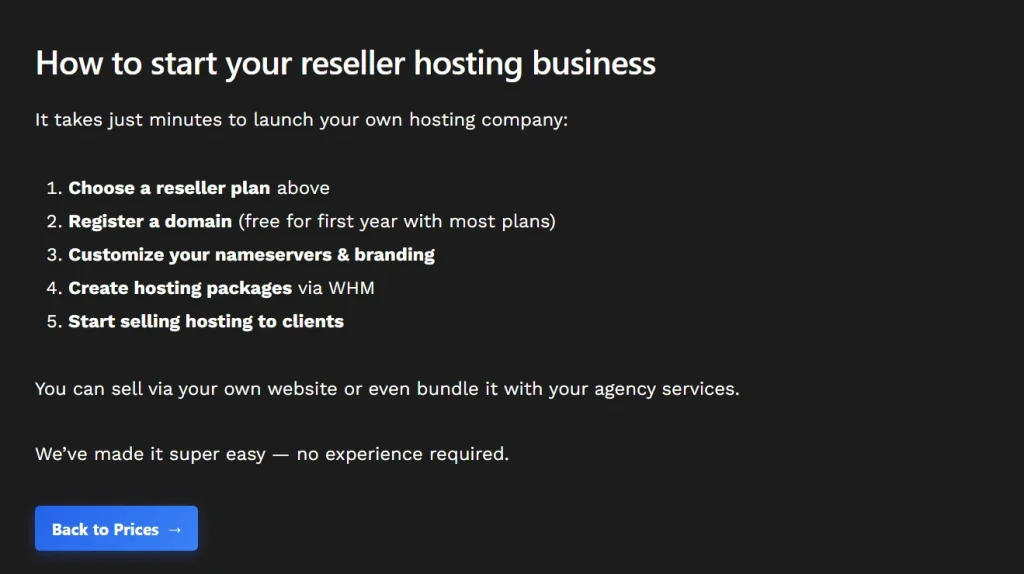
Step 1: Choose the Right Reseller Hosting Provider
Your choice of provider affects everything from day one. A weak provider means slow websites and unhappy clients.
A good provider means stable uptime and easy account management for you.
Look for these things when evaluating a provider:
- A 99.9% or higher uptime guarantee in their service agreement
- WHM and WHMCS are included in the plan, not sold as costly add-ons
- Private nameservers are supported so that you can brand your hosting fully
- Independent reviews from real users, not just the provider’s own testimonials
Step 2: Register a Local Domain and Set Up Your Branding
Your domain name creates the first impression for every potential client. Register a .co.tz domain for stronger local trust signals.
A .co.tz domain tells Tanzanian clients immediately that you are a local business.
After registering your domain, configure your private nameservers right away. Use ns1.yourcompany.co.tz and ns2.yourcompany.co.tz for your domain settings.
Contact your parent provider for the IP addresses you need to point them to correctly.
Next, create a simple hosting website that lists your packages, prices, and contact details.
Add your logo and a professional business email such as [email protected].
These two things make your business look credible and trustworthy from day one.
Step 3: Build Your Hosting Packages and Set Your Prices
Many new resellers make one common mistake at this stage. They undercharge and leave money on the table from the very start. A clear pricing structure prevents that from happening.
Here is a straightforward profit example to guide your thinking. Suppose your reseller plan costs TZS 50,000 per month and includes 30GB of storage.
You split that storage into six packages of 5GB each. You sell each package at TZS 15,000 per month.
That gives you TZS 90,000 in monthly revenue against a monthly cost of TZS 50,000.
Name your packages clearly so clients can self-select the right one. A Basic package works well for blogs and personal websites.
A Business package suits growing SMEs with more traffic. A Premium package serves agencies and e-commerce stores with higher needs.
Bundle SSL certificates, domain registration, and business email into your higher-tier packages.
Step 4: Accept Payments from Tanzanian Clients
Most Tanzanian clients prefer to pay via mobile money platforms they already use daily.
M-Pesa, Airtel Money, and Tigo Pesa are the three most common options in the market.
Accepting these methods removes the biggest payment barrier for local clients.
WHMCS supports payment gateways, but some Tanzanian mobile money integrations require custom setup work.
For smaller client bases, a manual payment process works well enough at first.
You accept mobile money payments and then manually activate client accounts in WHM.
Set up bank transfer as an additional option for corporate clients as well. Some organizations cannot pay via mobile money because of internal accounting policies.
Offering multiple payment methods means fewer lost sales and a more professional service offering.
Step 5: Provide Support and Keep Your Clients
Your support role has a clear boundary that you should communicate to clients.
You handle the client-facing questions about websites, emails, and account settings.
Your parent provider handles server-level issues, outages, and hardware problems.
For most clients, support is provided via WhatsApp messages. Many small Tanzanian businesses communicate almost entirely through it during working hours.
Create a simple system to track messages and respond within a few hours. Escalate server-level issues to your provider promptly.
Communicating with clients in Swahili is a competitive advantage most international providers cannot match. It builds trust and loyalty faster than any discount can.
Clients who feel genuinely understood stay longer and refer their friends and colleagues to you.
How Much Can You Earn from Reseller Hosting in Tanzania?
Reseller hosting income grows steadily as your client base grows. It also increases when you bundle more services into each client relationship.
Here are the numbers at different client scales.
| Clients | Monthly Revenue | Plan Cost | Monthly Profit |
| 10 | TZS 150,000 | TZS 50,000 | TZS 100,000 |
| 50 | TZS 750,000 | TZS 50,000 | TZS 700,000 |
| 100 | TZS 1,500,000 | TZS 50,000 | TZS 1,450,000 |
These figures use a base rate of TZS 15,000 per client per month against a TZS 50,000 plan cost.
In practice, income per client rises when you add domain registration, SSL renewals, and website maintenance fees.
Reseller hosting income also becomes predictable once clients renew on a monthly or annual cycle.
Annual payment plans improve cash flow because you receive 12 months of income at one time.
They also reduce the risk of clients canceling at the last minute.
Frequently Asked Questions
Can I start a hosting business in Tanzania without technical skills?
Yes, you can start a reseller hosting agency without any technical skills. Your hosting provider will handle all the technical coding and server management, leaving you to deal with the marketing and client management tasks.
How much does reseller hosting cost in Tanzania?
The cost of reseller hosting plans depends on the number of cPanel accounts per package. Plans range from TZS 60,000 to TZS 250,000 per month.
Can I use my own brand name with reseller hosting?
Yes, you get private nameservers and can use your own logo, colors, and client interface while the parent provider stays completely in the background.
How many clients do I need to make reseller hosting profitable?
The break-even point will depend on how much you decide to charge your clients, plus how much your subscription to the service provider costs.
What is the difference between shared hosting and reseller hosting?
Shared hosting gives you space on a server for your own single website. You cannot use a shared plan to sell hosting to other people. Reseller hosting gives you a block of server resources inside WHM instead.
You divide that block into individual cPanel accounts for each client. Each account functions as that client’s own separate hosting space.
Conclusion
Reseller hosting is not a shortcut to fast income. It rewards people who show up consistently, support their clients well, and market themselves locally.
If that sounds like work you are willing to do, the Tanzanian market has more than enough room for another reliable local provider. Most clients are still searching for one.